Individual ownership.
Collective scale.
Project Chittoor redefines rural industrialization through an integrated hub strategy that preserves farmer land rights while unlocking the efficiencies of institutional-grade infrastructure.
Your land stays yours. Its potential becomes collective.
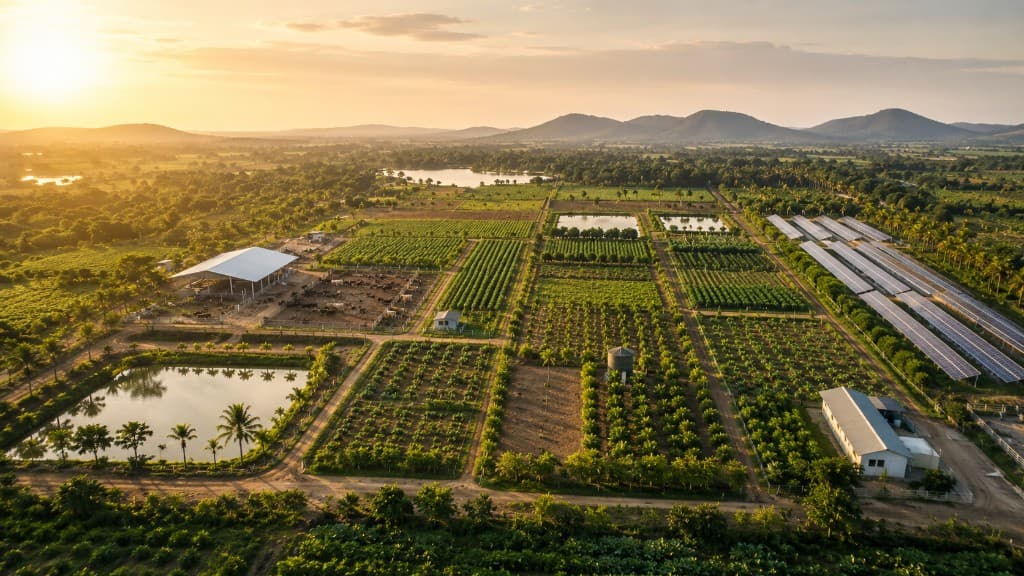
Land enters the framework through a community development trust. Title never transfers. Participating families commit their land for a seven-year development horizon, during which the trust builds shared infrastructure — fencing, water systems, irrigation, livestock facilities, solar — that no one-acre holding could justify alone.
Returns flow back on two dimensions: the land a family contributes, and the work hours its members put in. Landowners who also work the clusters earn on both. The framework aligns everyone — owner, worker, operator — around the same outcome: productive, regenerating land.
Mechanics as reported by Business Standard, June 2026. Participation is governed by formal agreements; this page is a plain-language summary, not an offer.
Trust flow (summary)
- 1Family retains land title
- 2Land enters community development trust
- 3Shared infrastructure built over 7 years
- 4Returns by land size + work hours
Every acre gets cheaper to transform.
Early redevelopment cost ₹7–8 lakh per acre as the team tested approaches. Codified operations have brought that down to ₹2.5–3 lakh, with a target of ₹2 lakh — the point at which the model becomes rapidly replicable across districts. This is the quiet engine of the roadmap: a falling cost curve funded by rising, diversified revenue.
Reported figures are drawn from independent media coverage and are subject to internal verification.
Redevelopment cost per acre
The 30-acre block: a complete rural enterprise.
Each block is a self-contained economy. Vegetables and fruit provide seasonal income. Timber and fruit tree belts build long-duration asset value while sheltering soil and water. A livestock unit — around 200 sheep and 20 cows per block — delivers recurring income from the first months and returns manure to the fields, closing the nutrition loop. Elevated agrivoltaic arrays of roughly 300 kW per 1–1.5 acre installation generate power for the block's pumps, cold storage, dryers and packhouse — with shading that reduces heat stress and evaporation for the crops below, and surplus energy sold as an additional revenue line.
Three revenue engines — agriculture, livestock, solar — on one asset base, each one hedging the others against weather, price and season.
Block configuration as reported in launch coverage, April–June 2026. Solar capacity figures are PLANNED until commissioning is verified.
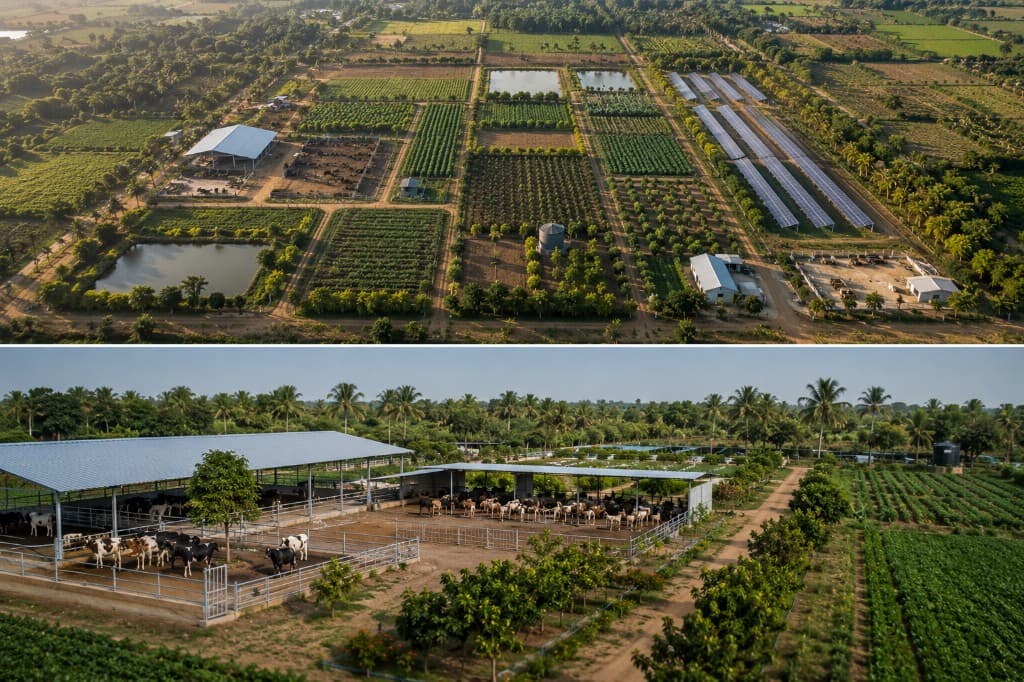
Block anatomy
- Crop beds — seasonal vegetables and fruit
- Tree belts — timber and fruit assets + shelter
- Livestock shed — ~200 sheep and ~20 cows per block
- Water structures — ponds, trenches, drip
- Agrivoltaic rows — ~300 kW per 1–1.5 acre installation (PLANNED)
- Packhouse / cold storage / dryers
- Internal access roads
From survival income to prosperity income.
The framework sets a deliberate, staged trajectory for participating land: ₹30,000+ per acre annually within three years of development, rising past ₹60,000, toward a long-term target of ₹1 lakh+ per acre per year. These are targets, not guarantees — but they are targets backed by an operating model already generating ₹1.5–2 lakh in daily revenue across the first 600 developed acres.
Reported figures are drawn from independent media coverage and are subject to internal verification.
Income per acre / year
- BaselineFallow / leasedREPORTED
- Year 3₹30k+TARGET
- Mid-term₹60k+TARGET
- Long-term₹1L+TARGET
Income Architecture
Diversified revenue streams ensure resilience against market volatility while maximizing land productivity across every hectare.
- Agriculture
- Livestock
- Solar
- Agroforestry
- Processing
Institutional Trust Framework
Legal agreements preserve individual land ownership while enabling institutional-scale operations. All governance terms are subject to verification and periodic audit.